Tag: Productivity

  • A System to Be Paid a World-Class Sum.

    Producing world-class work is essential for achieving remarkable success. We all understand that work is inevitable—without it, no value is created, and without value, there is no money.

    Money, in essence, is merely a representation of the value created by work. So, the critical question is: How can one create work of massive value?

    Understanding Value.

    Value isn’t fixed; it depends on the economy and how a particular type of work is perceived within it. For work to hold immense value, it must be:

    1. Unique and hard to replace

    2. Significant enough to fulfill societal needs

    Your ability to produce valuable work stems from intrinsic factors, such as your capacity to focus deeply and practice deliberately. It all boils down to how you manage your time, energy, and effort.

    Shifting Focus to Yourself.

    The key lies in taking control of what’s within your power:

    How effectively are you spending your time?

    What are you dedicating your energy to?

    When you focus on these aspects, you can take essential steps to create meaningful value in the world—and be compensated accordingly.

    The Energy Loop: A Method for Productivity

    To maximize effectiveness, I developed a method I call the Energy Loop—a system I stumbled upon accidentally but later realized its immense value.

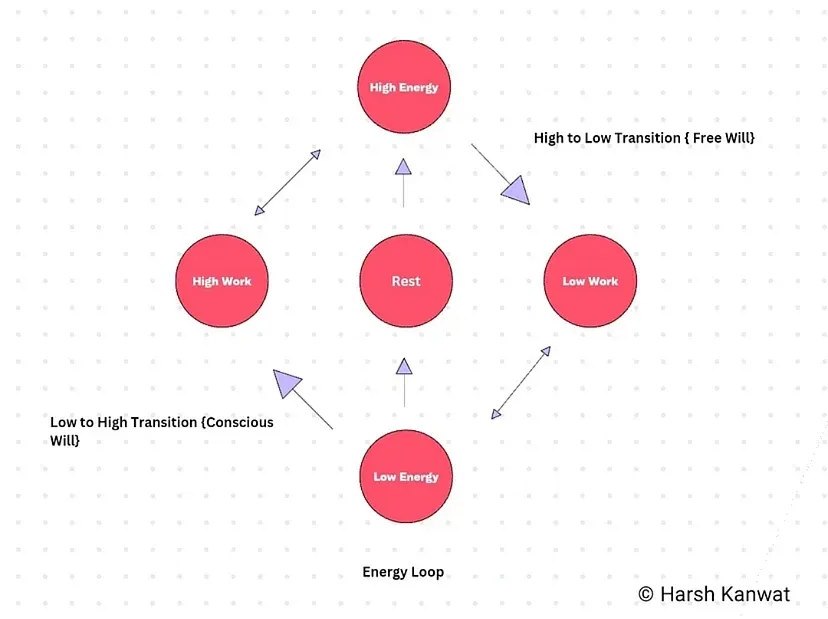
    I call it a “loop” because it mirrors the way our energy flows, which ultimately dictates how our lives unfold. The Energy Loop comprises four parts:

    1. High Energy

    2. High Work

    3. Low Energy

    4. Low Work

    5. Rest

    When used correctly, this system helps you manage your energy more efficiently, leading to greater productivity.

    The Energy Loop in Action.

    1. High Energy: Start Strong

    We often begin our day with high energy, making it the best time to tackle high-output work—tasks that are deep and create long-term value.

    2. High Work: Stay Focused

    As the day progresses, distractions and shallow tasks can drain your energy. When your energy drops, it naturally pulls you toward low-quality work that further exhausts you.

    3. Low Energy: Recognize the Dip

    At this stage, you have two options:

    Use conscious willpower to continue high-quality work.

    Take a strategic rest.

    4. Rest: Recharge Effectively

    Rest isn’t just downtime; it’s a critical part of the loop. Effective rest helps you regain lost energy, which you can then channel into productive activities. Consider activities like:

    Napping

    Walking

    Taking a warm bath

    Practicing mindfulness or breathing exercises

    The better you understand and manage your energy flow, the more effective and fulfilling your life becomes.

    The World-Class Equation

    Ultimately, if you want to be paid a world-class sum, you must produce world-class work.

    If you aim to make millions, create work worth millions.

    If you aspire to make billions, deliver work worth billions—or at least ensure it’s perceived as such.

    By mastering your energy and focusing on high-value contributions, you can elevate both your work and your rewards to a world-class level.

    Read this for more understanding.

  • Navigating Desperation: Finding Balance in the Pursuit of Success.

    In today’s fast-paced world, many of us feel the pressure to set ambitious goals and deadlines, believing that urgency will propel us to success.

    And while there’s value in being driven, I’ve come to realize that desperation is not the answer. Desperation—what I see as “doing too much too soon”—often leads to burnout and, ultimately, failure.

    It disrupts the balance we need in our lives, triggering a fight-or-flight response that can cloud our judgment and make it difficult to think clearly.

    The Paralyzing Effect of Negative Emotions.

    Negative emotions, like anxiety and desperation, can seriously mess with our ability to think straight.

    Studies back this up. For example, research published in the Journal of Neuroscience found that anxiety actually reduces activity in the prefrontal cortex—the part of our brain responsible for decision-making and problem-solving. When this happens, we can feel stuck, unable to find a way forward.

    On top of that, cognitive behavioural therapy (CBT) teaches us that negative emotions distort our thinking.

    When we’re overwhelmed by desperation, we’re more likely to engage in catastrophic thinking, imagining the worst possible outcomes, which only adds to our sense of helplessness.

    Desperation vs. Enthusiasm: Two Different Paths.

    Desperation often hits when we feel swamped by life’s uncertainties. Instead of being driven by excitement, many of us operate out of urgency and fear. This makes us fragile in the face of setbacks.

    Stephen Covey, the time management guru, called this “crisis management”—a reactive way of dealing with life where we focus all our energy on the latest problem, neglecting other important areas. This lack of balance just creates more crises down the road.

    But there’s a better way: working from a place of enthusiasm rather than desperation.

    Positive psychology, particularly Mihaly Csikszentmihalyi’s concept of Flow, shows us that when we’re fully engaged and excited about our work, we’re more productive and satisfied.

    Enthusiasm helps us see challenges as opportunities, not threats, making us more creative and resilient.

    Enthusiasm helps us see challenges as opportunities, not threats, making us more creative and resilient.

    The Limits of Our Senses and the Power of Belief.

    One reason desperation is so damaging is that it often stems from our overreliance on our senses.

    We tend to trust only what we can see and touch, but our senses can deceive us. Take the Invisible Gorilla Experiment, for instance. This study shows how easily we can miss critical details, proving that our sensory perceptions are limited.

    This is where belief comes into play. Cognitive dissonance research tells us that people often struggle to accept ideas that contradict their sensory experiences, which limits what they think is possible. To truly succeed, we need to believe in possibilities that aren’t immediately visible, breaking free from the limitations of our senses.

    Overthinking Isn’t the Problem—Overreacting Is.

    We’ve all heard that overthinking leads to anxiety and indecision.

    But what if it’s not the thinking that’s the issue, but the way we react to our thoughts? Cognitive Load Theory suggests that when our brains are overloaded with information, we get mentally fatigued, which can make it hard to think clearly.

    This isn’t about too much thinking—it’s about emotional overreaction to the situation.

    Mindfulness is a powerful tool that can help us counter this overreactive state.

    Research shows that mindfulness reduces emotional reactivity, helping us approach problems with a calm, deliberate mindset.

    It supports the idea that thinking is a skill we need to develop, rather than something that just happens on its own.

    Creating a Balanced Life: The Real Key to Fulfillment.

    So what’s the big takeaway here? Balance is everything. Success isn’t about pushing yourself harder or faster out of desperation; it’s about finding equilibrium in your life.

    You need to give attention to all the important areas—work, personal life, self-care.

    Research in organizational psychology shows that people who manage to maintain this balance are more likely to achieve long-term success and fulfillment.

    In conclusion, if you want to lead a fulfilling life, avoid the trap of desperation. Focus on developing a balanced approach to work and life. Cultivate enthusiasm, believe in possibilities that aren’t immediately obvious, and keep your emotions in check.

    Success isn’t just about ambition; it’s about thoughtful, balanced effort.