Author: harshkanwat

  • The Purpose Delusion: How Society Traps You in a Fake Quest.

    How many times have you been told to find your purpose?

    Society, culture, and self-help books all seem to emphasize this idea, as if purpose is some hidden treasure waiting to be discovered. Yet, most people struggle with it. Some search their whole lives, while others assume their job title or role in society is their purpose.

    But what if we’ve been thinking about purpose the wrong way?

    In this article, I want to offer a different perspective—one that might help you see purpose in a new light and, more importantly, recognize it in your own life.

    A Simple but Powerful Question

    There’s one question I often ask myself when reflecting on purpose:

    If I had been born 1,000 years ago, would my purpose still be the same?

    Think about it.

    Would your purpose change if you lived in ancient times, in a different culture, or under completely different circumstances?

    If your answer is yes, then what you’re calling “purpose” might just be a career or a role you’ve attached yourself to. But if your answer is no, then you’re closer to understanding something deeper—because real purpose isn’t about what you do, but why you do it.

    The Trap Most People Fall Into

    Here’s where many people get stuck. They focus too much on what they want to do—becoming a doctor, an artist, a business owner—without questioning why they are drawn to it in the first place.

    And that’s a dangerous trap.

    Because when life throws challenges at you (which it will), or when you start feeling lost (which happens to everyone), you may begin to question your entire sense of purpose.

    This is why many people feel unfulfilled, even after achieving their dreams. They work hard to reach a goal, only to realize it doesn’t bring them the deep satisfaction they expected.

    Why?

    Because they never connected with the why behind their actions.

    And when you don’t have a strong why, you risk becoming just another average person in your field—an average doctor, an average artist, an average entrepreneur.

    But those who tap into their why—the deeper reason behind their work—are the ones who become truly exceptional.

    Purpose: Internal, But Expressed Externally

    Now, let’s go back to that original question.

    Would your purpose be different if you lived 1,000 years ago?

    Here’s why this question matters:

    Purpose is not tied to external circumstances. Whether you live in an era of war or peace, whether you’re a warrior, a philosopher, or a businessperson, your purpose remains the same—it simply finds different expressions.

    Purpose is not about doing—it’s about being. What you do may change over time, but the why behind it is constant.

    Purpose is about self-expression, not a job title. Too many people define themselves by their careers, but purpose is much bigger than that.

    Your real purpose is about using life as a field of experience to grow and evolve. The roles you play along the way are just expressions of that deeper purpose.

    Forget the “What.” Start With “Why.”

    Many people think of purpose as some grand, external thing they need to chase. But the truth is, purpose isn’t something you find—it’s something you recognize within yourself.

    It’s not about asking what you want to do. Instead, ask:

    Why do I feel pulled toward this path?

    Why does this matter to me?

    Why do I feel most alive when I do this?

    When you start with why, everything else begins to make sense.

    A Real-Life Example

    Let’s say someone is considering becoming a politician but isn’t sure if it’s the right path.

    If they ask themselves, “Why do I want to be a politician?”, they’ll come up with logical reasons—some for, some against. But this kind of reasoning alone won’t reveal their true purpose.

    Instead, they should ask:

    Do I believe the world is heading in the wrong direction?

    Do I feel an urge to create change?

    Do I feel most alive when I help solve big problems?

    If the answer is yes, then politics is just one way to express their purpose. If not, then politics is just an idea, not a calling.

    This applies to every career, every ambition, every dream. Purpose isn’t about the specific job—it’s about the underlying reason that drives you.

    Final Thoughts: Purpose Is Already Within You

    Here’s what I hope you take away from this:

    Your purpose is not a job title. It’s not a career path. It’s not something you need to find.

    It’s already within you.

    The world will constantly try to define your purpose for you—based on money, status, or social expectations. But the real question is:

    Will you let them?

    Purpose isn’t about what you do. It’s about why you do it. And when you truly understand your why, the what will take care of itself.

  • A System to Be Paid a World-Class Sum.

    Producing world-class work is essential for achieving remarkable success. We all understand that work is inevitable—without it, no value is created, and without value, there is no money.

    Money, in essence, is merely a representation of the value created by work. So, the critical question is: How can one create work of massive value?

    Understanding Value.

    Value isn’t fixed; it depends on the economy and how a particular type of work is perceived within it. For work to hold immense value, it must be:

    1. Unique and hard to replace

    2. Significant enough to fulfill societal needs

    Your ability to produce valuable work stems from intrinsic factors, such as your capacity to focus deeply and practice deliberately. It all boils down to how you manage your time, energy, and effort.

    Shifting Focus to Yourself.

    The key lies in taking control of what’s within your power:

    How effectively are you spending your time?

    What are you dedicating your energy to?

    When you focus on these aspects, you can take essential steps to create meaningful value in the world—and be compensated accordingly.

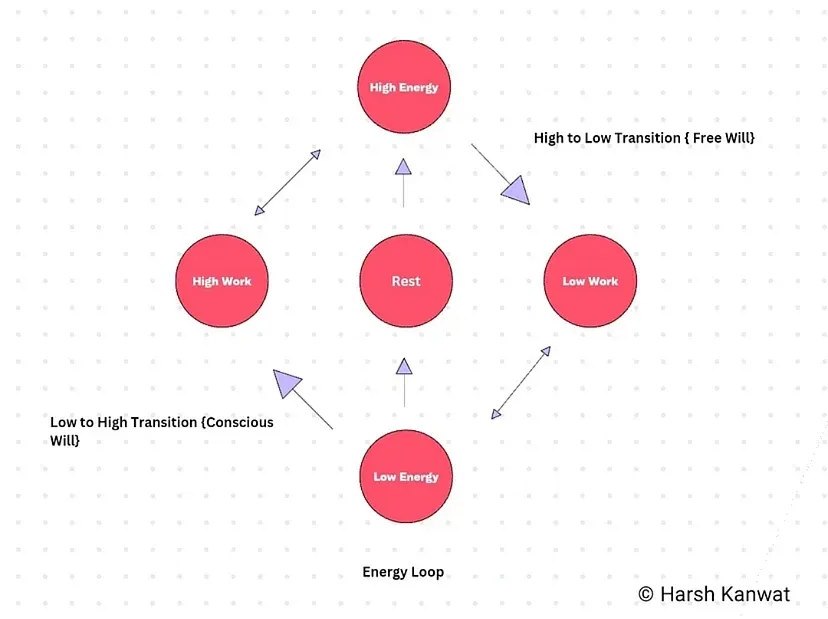
    The Energy Loop: A Method for Productivity

    To maximize effectiveness, I developed a method I call the Energy Loop—a system I stumbled upon accidentally but later realized its immense value.

    I call it a “loop” because it mirrors the way our energy flows, which ultimately dictates how our lives unfold. The Energy Loop comprises four parts:

    1. High Energy

    2. High Work

    3. Low Energy

    4. Low Work

    5. Rest

    When used correctly, this system helps you manage your energy more efficiently, leading to greater productivity.

    The Energy Loop in Action.

    1. High Energy: Start Strong

    We often begin our day with high energy, making it the best time to tackle high-output work—tasks that are deep and create long-term value.

    2. High Work: Stay Focused

    As the day progresses, distractions and shallow tasks can drain your energy. When your energy drops, it naturally pulls you toward low-quality work that further exhausts you.

    3. Low Energy: Recognize the Dip

    At this stage, you have two options:

    Use conscious willpower to continue high-quality work.

    Take a strategic rest.

    4. Rest: Recharge Effectively

    Rest isn’t just downtime; it’s a critical part of the loop. Effective rest helps you regain lost energy, which you can then channel into productive activities. Consider activities like:

    Napping

    Walking

    Taking a warm bath

    Practicing mindfulness or breathing exercises

    The better you understand and manage your energy flow, the more effective and fulfilling your life becomes.

    The World-Class Equation

    Ultimately, if you want to be paid a world-class sum, you must produce world-class work.

    If you aim to make millions, create work worth millions.

    If you aspire to make billions, deliver work worth billions—or at least ensure it’s perceived as such.

    By mastering your energy and focusing on high-value contributions, you can elevate both your work and your rewards to a world-class level.

    Read this for more understanding.

  • The Secret Behind Great Opportunities: How They Work and How to Spot One to Change Your Life Forever.

    Maybe you’ve heard countless times that all you need is one big idea—a perfect opportunity to change your life. For a while, you believe it and hope for it, but when you see no change, you turn away from it and conform to the usual path taken by most people.

    Why do so many people spend their whole lives hoping for one perfect opportunity yet never seem to find it? What are they doing wrong?

    Why do a few people find the right opportunity at the right time, creating a radical change? What are they doing differently? And how can you find it too, to uplift your life?

    A lot of people live miserably—they do work they don’t love or aren’t proud of. They just work for money. They chase money, but when they bring it home, they can’t use it for their growth.

    Many people hope for big breakthroughs. They’re the ones who dream of billion-dollar startups or overnight fame.

    But here’s the truth: great opportunities are recognized from within, not through external sources.

    Opportunities rarely come directly; they usually appear after a series of steps you need to take. Often, they depend on what you do and how proactive you are.

    If you want to build a billion-dollar business, you have to start somewhere. You can use those experiences when the right idea hits. At that point, the experience you’ve gained will help you execute it better and potentially grow a billion-dollar company.

    The key lesson to remember is that no business is inherently worth billions—the value comes from execution. How well do you execute?

    Every company began at the bottom. Sometimes it’s not the idea that’s worth billions but the execution that turns a million-dollar idea into a billion-dollar one.

    At the same time, you’ll find many people with great ideas—ideas with billion-dollar potential—who failed because they couldn’t execute them effectively.

    The Trick of Opportunity

    Napoleon Hill captures it perfectly in Think and Grow Rich  :

    “When the opportunity came, it appeared in a different form, and from a different direction. That is one of the tricks of opportunity. It has a sly habit of slipping in by the back door, and often comes disguised in the form of misfortune, or temporary defeat. Perhaps this is why so many fail to recognize opportunity.”

    Opportunities are often hidden within setbacks and challenges, disguised in ways that make them easy to overlook. Many people miss them because they expect opportunity to appear in a clear, ideal form. But the truth is, opportunity may arise from a failed project, a difficult lesson, or even an unexpected pivot in life.

    Be Active, Explore, and Understand How Things Work.

    If you want to spot more opportunities in life—whether for making money, growing, or something else—you need to start doing something, anything you enjoy, while also understanding how things work. Consider questions like:

    If you want to start an AI company, ask, How does AI really work?

    If you want an online side hustle, ask, How do people make money online?

    All great ideas are the result of many previous ideas. So if you want one big idea, you need many small ideas to build the foundation.

    Opportunities are everywhere, in abundance. But you need to be active and understand how things work.

    My Story:

    I never considered myself a writer. In the beginning, I held biases like many people: writers are boring, they just write all day, and other stereotypes fueled by media. But I learned through experience that most of these biases are false.

    In my story, I want to share a pattern you can use to spot more opportunities in your life too. It’s a pattern I’ve noticed in many people’s stories—let me start with mine.

    Over a year ago, I struggled to organize my thoughts, so I began journaling. Every morning, I wrote morning pages, and within a few months, I noticed a tremendous clarity in my thinking. My thoughts were more organized.

    At the same time, I started writing articles on Medium and discovered that writing is just a natural process—a way of expressing oneself in words. I realized that everyone writes in some form, so everyone is, in a way, a writer.

    After realizing I could write articles, I began writing on my website: harshkanwat.com.

    The lesson is clear: one thing leads to another, one opportunity opens up others. If you wait for the perfect opportunity, it may never come, and you could spend your whole life regretting it.

    So, start now with the obvious. Change your perception of things and seek the truth for yourself.

  • Hyperconnected World: Do We Need Social Media to Be Social?

    Let’s take a moment to reflect. Have you ever found yourself mindlessly scrolling through social media, only to feel more disconnected than connected?

    In today’s hyperconnected world, it seems like we’re always plugged into something.

    We’re bombarded by information, notifications, and ads, and yet, many of us feel less satisfied, less content, and somehow more anxious. But why?

    Why Are We Unhappy Despite Having So Much?

    Think about it—most of us have more material comforts than past generations, yet we often feel unhappy or dissatisfied. One key reason is overstimulation. Social media makes it so easy to compare ourselves to others.

    Every day we see someone’s dream vacation, new promotion, or perfectly curated lifestyle.

    Even though we logically know these are just highlight reels, we can’t help but feel envious or inadequate.

    But it wasn’t always like this. Previous generations had fewer material goods, but many seemed happier.

    Why? It boils down to this: they weren’t constantly comparing themselves to hundreds of people at once. Their world was smaller and their comparisons were local—to their neighbors, friends, and family.

    In contrast, today’s digital world gives us a never-ending stream of comparisons, making us feel like we’re always behind.

    How Does Social Media Trigger Unhappiness?

    Here’s something interesting: research shows that the more time you spend on social media, the more likely you are to feel emotions like envy.

    Think about it: if you spend hours seeing everyone’s best moments, it’s natural to wonder why your own life doesn’t look the same.

    Psychologists call this the highlight reel effect. People only post the good stuff, but we start to think their lives are perfect while ours are flawed.

    Social media also floods our brains with dopamine, the same chemical that makes us feel good when we eat chocolate or win a game.

    But here’s the catch: social media keeps us craving more. Every like, comment, or notification gives us a hit of dopamine, but when we don’t get that validation, it leaves us feeling anxious or unsatisfied.

    Were Past Generations Happier?

    Let’s go back in time for a minute. Life was undoubtedly tougher in many ways—people worked harder physically, had fewer conveniences, and their lives weren’t documented for the world to see. Yet many were content. Why?

    For one, they were more present. Without smartphones or social media, people spent more time engaged with those around them.

    They weren’t distracted by notifications or overloaded with information. This allowed them to build deeper connections with themselves and others.

    Sherry Turkle, a professor at MIT, argues that digital communication lacks the emotional richness of in-person interaction.

    The older generations had a gift of being able to form strong, face-to-face social bonds that we often lack today.

    Does Social Media Make Us More Social?

    Now, let’s tackle a big question: Do we need social media to be social? The simple answer is ‘no’.

    Yes, social media allows us to stay in touch with people, but it often leads to shallow, surface-level interactions.

    Most people use platforms like Instagram, TikTok, or Facebook to showcase parts of their life or promote businesses rather than build deep connections.

    In fact, studies show that while we may have hundreds or even thousands of “friends” or “followers,” these relationships often lack the depth of real-world friendships.

    Many of us feel lonelier even though we’re constantly “connected.”

    In reality, these platforms are becoming more like marketplaces for attention and less about meaningful connection.

    Jean Twenge, a psychologist, notes that younger generations report feeling lonelier despite being the most connected digitally. This constant comparison and lack of genuine interaction lead to emotional emptiness.

    Conclusion: Reclaiming Authentic Connection

    So, do we need social media to feel connected? Not really.

    What we truly need is deeper, more authentic human connections—ones that go beyond the digital world. By stepping away from the overstimulation and comparison traps of social media, we can start reconnecting with ourselves and those around us in a meaningful way.

    Remember, real connection isn’t about the number of likes, comments, or followers—it’s about the quality of our interactions. So maybe the next time we feel the urge to scroll, we can choose instead to call a friend, enjoy the present moment, or simply take a break from the noise.

  • The Future of Technology: Why Rapid Advancement Requires Spiritual Growth.

    The Double-Edged Sword of Technology

    Technology has changed our lives in so many amazing ways. From how we communicate to how we work, it’s made everything faster, easier, and more connected.

    But with all this advancement, we’ve also come to rely on it so much that, in some ways, it starts to control us. If we don’t keep our personal growth balanced with our technological progress, we risk becoming limited by the very tools that are supposed to free us.

    The Speed of Technological Change vs. Education.

    One of the biggest challenges we face today is that technology is advancing at lightning speed, but the education system that’s supposed to teach us about these new technologies is lagging behind.

    Think about it—by the time a curriculum is developed, approved, and implemented, the technology it’s meant to teach has often already evolved or become outdated.

    For example, fields like artificial intelligence, quantum computing, and biotechnology are growing exponentially, but most schools and universities are still using old teaching methods that don’t adequately prepare students for the jobs of the future.

    According to a report by the World Economic Forum, 65% of children entering primary school today will eventually work in jobs that don’t even exist yet. So, how can we expect education to keep pace with such a rapidly changing landscape?

    It’s not just about learning how to use the latest gadgets or software. It’s about teaching critical thinking, creativity, and adaptability—skills that will help people navigate a world where change is the only constant.

    Without this, we risk creating a generation that is technologically savvy but lacks the deeper understanding necessary to use these tools wisely.

    The Missing Piece: Spirituality.

    I remember reading something that stuck with me for years:

    “Technology without spirituality is useless.”

    It’s a simple statement, but it says so much about the world we live in today. When we focus too much on technology, we lose sight of the bigger picture—why we even create these technologies in the first place.

    When I say “spirituality,” I don’t just mean religion. I’m talking about a deeper awareness of how everything is connected—people, nature, the universe.

    If we keep chasing technological advancements without understanding how they fit into the grander scheme of life, we’re missing something crucial.

    Thinkers like Fritjof Capra, who wrote The Tao of Physics, have long argued that we need to align our technological progress with the deeper principles of life, or we risk misusing it.

    Why Technology Alone Can’t Fix Everything.

    It’s clear that technology has given us so much, but look around—poverty, disease, terrorism, and mental health issues like depression and anxiety are still widespread.

    According to the United Nations, 9.2% of the world’s population still lives in extreme poverty, even though we’ve made so many scientific advancements.

    So why aren’t we solving these problems? Psychologist and sociologist Erich Fromm might have hit the nail on the head: we’ve become really good at controlling the outer world—mastering nature, curing diseases, building cities—but we’re still struggling to control the inner world, our emotions, and our sense of meaning.

    This inner world, the realm of consciousness and spirituality, is often neglected. And without mastering that, no amount of technological progress can truly make us happy or fulfilled.

    What Past Civilizations Can Teach Us.

    History has a way of repeating itself, especially when it comes to civilizations that rose and then fell.

    Many of the great civilizations of the past crumbled not because they lacked technology, but because they failed to balance their growth with sustainability, social harmony, and a deeper sense of purpose.

    – The Roman Empire: Rome was one of the most advanced civilizations in terms of infrastructure and military power.

    Yet, despite all their advancements, they eventually fell due to internal decay—moral corruption, economic inequality, and over-reliance on their military.

    As historian Edward Gibbon points out in his famous work, The History of the Decline and Fall of the Roman Empire, Rome collapsed because it lost its social and ethical cohesion.

    – The Mayans: The Mayans built incredible cities and had advanced knowledge of astronomy. But despite their technological achievements, their society collapsed, partly because of environmental damage and social unrest. They pushed their environment too far, and when it could no longer sustain them, their civilization declined.

    – Mesopotamia: Often called the “cradle of civilization,” Mesopotamia introduced us to writing, agriculture, and the first cities. But over time, deforestation, soil degradation, and over-reliance on irrigation weakened them.

    Historian Jared Diamond explains in his book Collapse that it wasn’t a lack of technology that doomed these societies, but their inability to manage their resources and social structures in a sustainable way.

    In each case, these civilizations fell because they couldn’t balance their advancements with the bigger picture—whether that was environmental sustainability, social harmony, or ethical living. Their downfall wasn’t due to a lack of technology, but a lack of wisdom.

    The Dangers of Unchecked Technology.

    Looking at history, we can see what happens when technological power is used without wisdom. Think about the atomic bomb—an incredible scientific achievement, but one that caused unimaginable devastation. The same technology that brought electricity into our homes also brought destruction to cities like Hiroshima and Nagasaki.

    Philosopher Lewis Mumford once said that technology has to align with human values, or it risks becoming dangerous. In other words, if we don’t use technology responsibly, it can quickly become a force for harm rather than good.

    Combining Consciousness with Technology.

    So, how do we avoid repeating the mistakes of the past? The answer lies in something many people overlook: consciousness.

    We need to become more aware of how we use technology, not just in terms of what it can do, but in terms of how it affects our lives and the world around us.

    There are already visionaries talking about merging human consciousness with technology. Think of people like Elon Musk, who’s working on projects like Neuralink, or physicist Michio Kaku, who talks about the future of AI and human evolution. These ideas may sound futuristic, but they’re already taking shape.

    The challenge is ensuring that as technology grows more powerful, our ethical and spiritual maturity grows along with it.

    If we can do that, we can use technology to lift humanity to new heights, rather than letting it divide or destroy us.

    Conclusion

    In the end, technology should be a tool that helps elevate us—not just a way to solve problems on the surface.

    For our civilization to truly thrive, we need to master both the outer world of technology and the inner world of consciousness. Only then can we create a world where technology serves humanity, rather than controlling it.

    By understanding the deeper laws of the universe and our place in it, we can ensure that the future is filled with abundance, growth, and harmony.
  • Navigating Desperation: Finding Balance in the Pursuit of Success.

    In today’s fast-paced world, many of us feel the pressure to set ambitious goals and deadlines, believing that urgency will propel us to success.

    And while there’s value in being driven, I’ve come to realize that desperation is not the answer. Desperation—what I see as “doing too much too soon”—often leads to burnout and, ultimately, failure.

    It disrupts the balance we need in our lives, triggering a fight-or-flight response that can cloud our judgment and make it difficult to think clearly.

    The Paralyzing Effect of Negative Emotions.

    Negative emotions, like anxiety and desperation, can seriously mess with our ability to think straight.

    Studies back this up. For example, research published in the Journal of Neuroscience found that anxiety actually reduces activity in the prefrontal cortex—the part of our brain responsible for decision-making and problem-solving. When this happens, we can feel stuck, unable to find a way forward.

    On top of that, cognitive behavioural therapy (CBT) teaches us that negative emotions distort our thinking.

    When we’re overwhelmed by desperation, we’re more likely to engage in catastrophic thinking, imagining the worst possible outcomes, which only adds to our sense of helplessness.

    Desperation vs. Enthusiasm: Two Different Paths.

    Desperation often hits when we feel swamped by life’s uncertainties. Instead of being driven by excitement, many of us operate out of urgency and fear. This makes us fragile in the face of setbacks.

    Stephen Covey, the time management guru, called this “crisis management”—a reactive way of dealing with life where we focus all our energy on the latest problem, neglecting other important areas. This lack of balance just creates more crises down the road.

    But there’s a better way: working from a place of enthusiasm rather than desperation.

    Positive psychology, particularly Mihaly Csikszentmihalyi’s concept of Flow, shows us that when we’re fully engaged and excited about our work, we’re more productive and satisfied.

    Enthusiasm helps us see challenges as opportunities, not threats, making us more creative and resilient.

    Enthusiasm helps us see challenges as opportunities, not threats, making us more creative and resilient.

    The Limits of Our Senses and the Power of Belief.

    One reason desperation is so damaging is that it often stems from our overreliance on our senses.

    We tend to trust only what we can see and touch, but our senses can deceive us. Take the Invisible Gorilla Experiment, for instance. This study shows how easily we can miss critical details, proving that our sensory perceptions are limited.

    This is where belief comes into play. Cognitive dissonance research tells us that people often struggle to accept ideas that contradict their sensory experiences, which limits what they think is possible. To truly succeed, we need to believe in possibilities that aren’t immediately visible, breaking free from the limitations of our senses.

    Overthinking Isn’t the Problem—Overreacting Is.

    We’ve all heard that overthinking leads to anxiety and indecision.

    But what if it’s not the thinking that’s the issue, but the way we react to our thoughts? Cognitive Load Theory suggests that when our brains are overloaded with information, we get mentally fatigued, which can make it hard to think clearly.

    This isn’t about too much thinking—it’s about emotional overreaction to the situation.

    Mindfulness is a powerful tool that can help us counter this overreactive state.

    Research shows that mindfulness reduces emotional reactivity, helping us approach problems with a calm, deliberate mindset.

    It supports the idea that thinking is a skill we need to develop, rather than something that just happens on its own.

    Creating a Balanced Life: The Real Key to Fulfillment.

    So what’s the big takeaway here? Balance is everything. Success isn’t about pushing yourself harder or faster out of desperation; it’s about finding equilibrium in your life.

    You need to give attention to all the important areas—work, personal life, self-care.

    Research in organizational psychology shows that people who manage to maintain this balance are more likely to achieve long-term success and fulfillment.

    In conclusion, if you want to lead a fulfilling life, avoid the trap of desperation. Focus on developing a balanced approach to work and life. Cultivate enthusiasm, believe in possibilities that aren’t immediately obvious, and keep your emotions in check.

    Success isn’t just about ambition; it’s about thoughtful, balanced effort.

  • Pain and Pleasure

    Most people when they hear about pain and pleasure, think that one is good while the other is bad and they form this perception just by seeing a small picture.

    For an immature mind, pain and pleasure are two things but for a wise mind, it is not two but one thing.

    As humans, we are hardwired to emotions. We are programmed to feel emotions and respond to those emotions.

    We are emotional beings, and we tend to react to the various emotions we feel throughout our human lives.

    An ignorant sees pain and pleasure as two different things and chases one while running from another, loves one and hates another.

    But a wise mind that has conquered emotions sees pain and pleasure as the same with no difference at all.

    In the mind of wisdom, a person with true wisdom doesn’t run away from pain and doesn’t chase pleasure.

    Pain is not that painful but the perception1 we have towards it makes it so fearful. The same is true with pleasure, there is pleasure beyond the human mind and body and only those who are enlightened can experience those blissful moments of pleasure.

    Both pain and pleasure are emotions and most people tend to react to those emotions rather than feeling them and that is why they increase the pain and suffering and reduce the pleasure they could have in life.

    They do not tend to feel pleasure to their full potential, they just settle for the minimum because of a lack of awareness and lack of self-control.

    Both pain and pleasure have only one purpose and that is increasing the understanding of the human mind. Pain and pleasure help us to be more aware and to be in absolute control rather than reacting to those emotions.

    When we do not react to our thoughts and emotions, we gain power. A tremendous power which has no equal, a power which is beyond any worldly power.

    When we don’t quit in pain2 and just feel the changes it brings inside us, we gain self-control. When we don’t fall for the alluring temptation of pleasure, we gain self-control.

    With better self-control and awareness, we can create anything we want in this world. We are only limited because of our inability to access the true power we each hold inside of us.

    1. Perception shapes meaning. ↩︎
    2. Pain gives meaning in life. ↩︎